International Student Support | South Asian Student Guides
Key Assessment Strategies That Support Honesty and Student Success
2 minutes of reading time
This blog explores essential assessment strategies in higher educat...
Summary
This blog explores essential assessment strategies in higher education that support academic integrity, encourage inclusive learning, ensure fair evaluation, and help students build skills relevant for their future careers.
Assessments go beyond tests and essays. When designed effectively, they encourage deeper learning, uphold academic integrity, and support students throughout their academic journey.
This post outlines practical strategies to make assessments fair, meaningful, and reliable for all students.

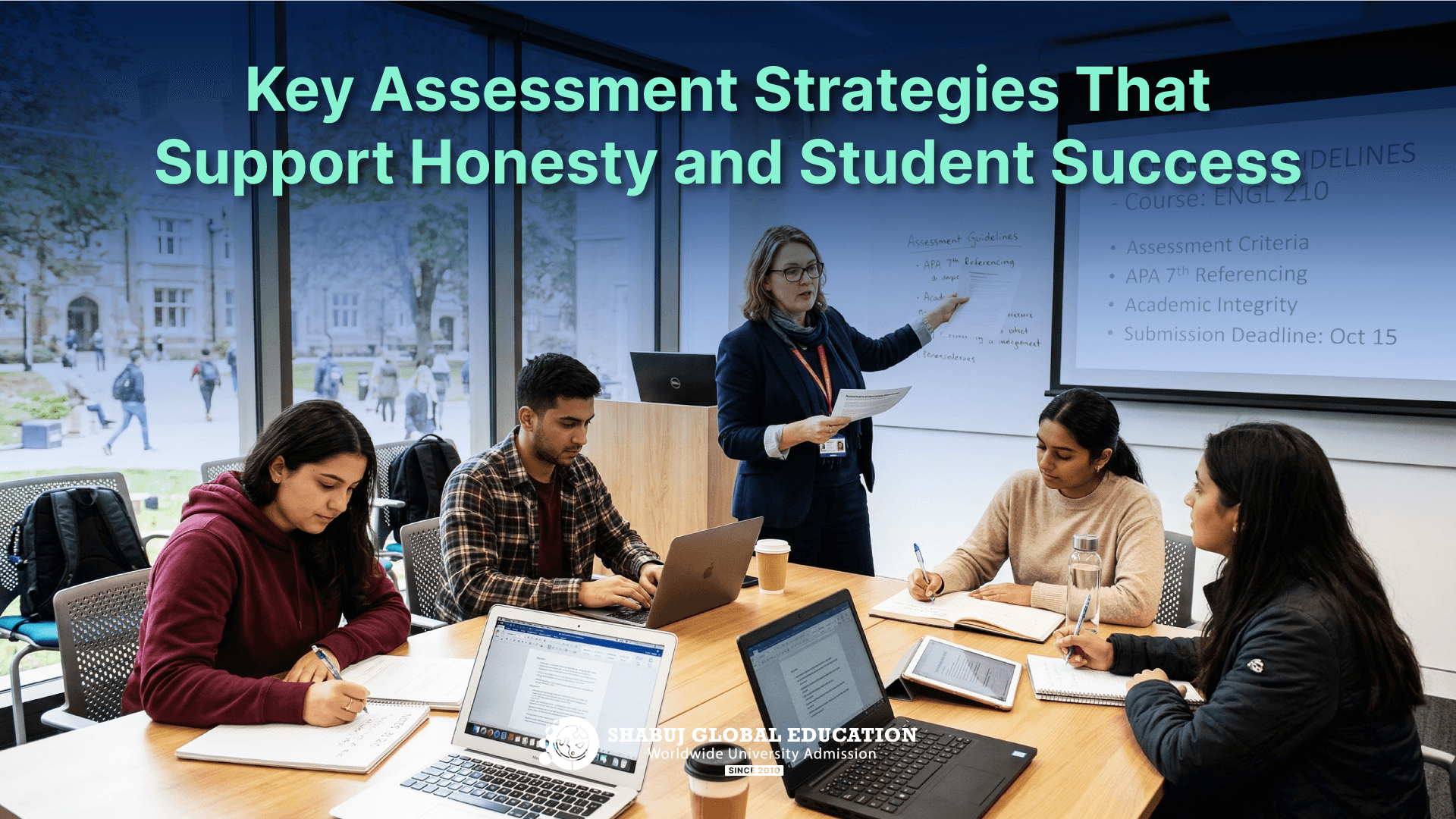
Collaborative assessment environments foster academic success and inclusive learning.
Why Smart Assessment Matters
Good assessment strategies in higher education help students understand what they’re meant to learn and show it clearly. They guide study habits, encourage responsibility, and reward genuine effort. Colleges like Bloomsbury Institute London design assessments to match learning goals and support students from start to finish.
When assessments are aligned with what students learn, it:
Reduces confusion about expectations
Encourages better preparation and learning
Supports promoting academic honesty across every task
Core Assessment Strategies at a Glance
Assessment Strategy | Primary Purpose | Direct Benefit for Students |
Academic Integrity Framework | Prevent misconduct and plagiarism | Builds ethical academic habits and trust |
Assessment Design | Create meaningful, valid evaluations | Improves retention and mastery of knowledge |
Faculty Expertise & Quality Assurance | Ensure standards and consistency | Fair, dependable grading and feedback |
Inclusive Assessment Models | Support diverse learner needs | Equal access and reduced barriers |
This table highlights the essential pillars that together form a strong assessment ecosystem.
Why Assessment Strategies Matter for Student Success
Assessments serve two key purposes: they measure learning and actively drive it forward. When universities implement thoughtful assessment strategies:
Students clearly understand what success looks like
Performance feedback helps learners improve
Academic honesty becomes a core value rather than just a rule
Without deliberate strategies, assessments can become inconsistent, stressful, and unfair. A well-structured system provides clarity, sets clear expectations, and helps students take ownership of their learning.
According to the Northern Illinois University Center for Innovative Teaching and Learning, assessment helps instructors collect evidence about student learning and evaluate whether teaching methods effectively support academic progress.
Academic Integrity: The Foundation of Honest Learning
Academic integrity frameworks keep learning honest. These systems include:
Clear policies about plagiarism and cheating
Mandatory integrity education for students
Tools that detect copied work
Transparent consequences and remediation
Academic dishonesty often comes from misunderstanding rather than intent. A clear integrity framework removes that ambiguity. When students know citation standards, collaboration boundaries, and ethical expectations, responsible academic behavior becomes the norm.
Assessment Design That Improves Learning Outcomes
Good assessment design is not about harder tests. It is about valid and fair measurement of learning. Key principles include:
Clear outcomes that link assessments to learning goals
Balanced methods such as projects, written assignments, and presentations
Rubrics that clearly explain grading criteria
For example, a research project requiring data analysis and reflection builds deeper academic and professional skills than a simple multiple-choice test. Effective assessment design rewards understanding, analysis, and real application of knowledge.
Faculty Expertise and Quality Assurance in Evaluation

Faculty expertise provides essential mentoring and personalized feedback that helps students understand academic standards.
Faculty members are not simply graders. They are guardians of academic standards. This requires:
Training in assessment best practices
Moderation processes to ensure consistent grading
Institutional quality assurance reviews
Without these systems, students may experience inconsistent feedback and unclear evaluation standards. When faculty expertise is combined with structured quality checks, students benefit from:
Fair grading
Meaningful feedback
Transparent academic expectations
A reliable evaluation system strengthens trust between students and institutions.
Inclusive Assessment Models for Diverse Learning Needs
Modern universities teach students from different countries, languages, and educational backgrounds. Inclusive assessments acknowledge this diversity by offering:
Flexible formats such as written, oral, or practical tasks
Accessibility support for students with disabilities
Clear instructions designed for international learners
Inclusive assessment does not lower academic standards. Instead, it removes unnecessary barriers that prevent students from demonstrating their knowledge. This approach ensures that all learners have a fair opportunity to succeed.
How Strong Assessment Systems Support Career Readiness
Assessment is not just about grades. It is about developing skills employers value. Well-designed assessments help students build:
Critical thinking
Communication skills
Real-world problem solving
Collaboration and ethical decision-making
When assessments reflect real-world tasks, students develop practical skills alongside theoretical knowledge. Employers increasingly value what graduates can do in practice, not just the grades they achieve.
These assessment methods also help students develop real-world abilities similar to those discussed in BA Business Management Skills to Make You a Successful Entrepreneur, where critical thinking and problem-solving skills are essential for future leaders.
Assessment Excellence at Bloomsbury Institute London
Our partner, Bloomsbury Institute London, designs its assessment systems around student success. Key practices include:
Transparent evaluation criteria
Diverse assessment formats reflecting real professional tasks
Continuous feedback to guide improvement
Academic support services such as writing assistance and mentoring
For international students, these systems make expectations clear and provide consistent guidance throughout their studies. Strong academic structures let students focus on learning instead of figuring out unclear requirements.
SGE helps students access these opportunities by providing personalized guidance on university applications, course selection, scholarships, and UK student visa preparation.
Study in the UK with Guidance from SGE
Assessment strategies are central to academic integrity and student achievement. To support honest learning and meaningful outcomes, universities must combine:
Clear integrity frameworks
Effective assessment design
Skilled faculty evaluation
Inclusive learning models
When these elements align, assessments go beyond grading. They build critical thinking, develop practical skills, and strengthen the confidence students need for long-term academic and professional success.
For students planning to study in the UK, understanding how universities design fair and effective assessment systems is crucial. Shabuj Global Education supports students throughout this process, ensuring a smoother transition into international higher education.
Take the first step toward your UK study journey today.
Book Your Free Consultation with Shabuj Global Education
Explore more
Frequently Ask Question