Careers & Job Opportunities | Study Abroad – UK
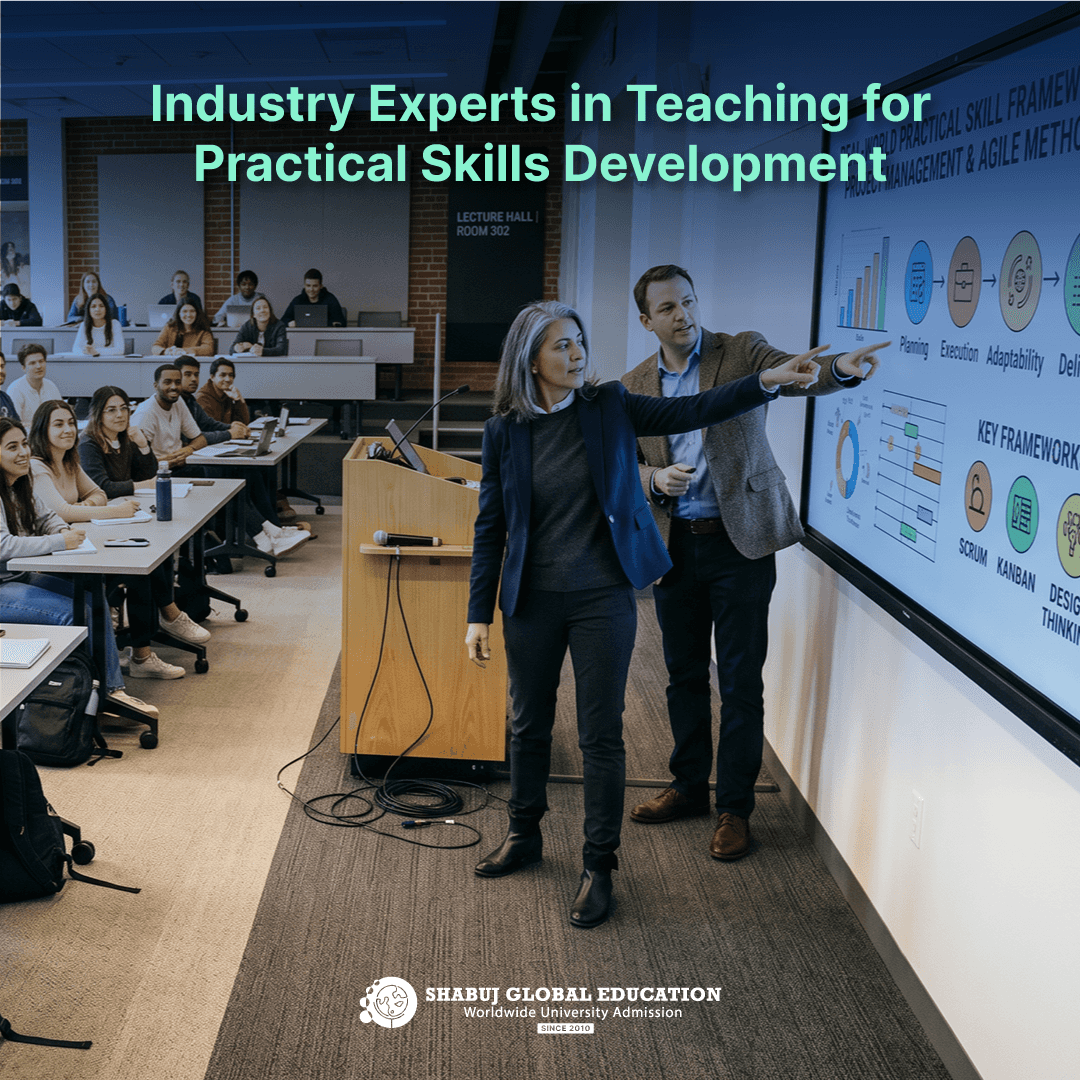
Industry Experts in Teaching for Practical Skills Development

2 minutes of reading time
This blog explains how industry experts enhance education through p...
Summary
This blog explains how industry experts enhance education through practical learning approaches. It explores hands-on training, case-based learning, and simulations that help students develop real-world skills and prepare for the workplace.
Apply for a UK Scholarship with Expert Guidance – Contact Us Today
Modern education is no longer effective if it focuses only on theory. Students need to understand how knowledge is applied in real work environments. This is where industry experts play an important role in teaching.
Rather than learning concepts in isolation, students gain insight into how those concepts are used in real-world situations. This helps shift education from passive learning to active skill development.
Explore the full system:External Industry Expertise in Education for Career Skills
How Industry Experts Teach in Classrooms
Industry experts change not just what students learn, but how they learn.
Their approach is centred on practical application. Rather than focusing on definitions and memorization, they structure lessons around real tasks, real problems, and real decision-making.
Key differences in their teaching approach include:
Emphasis on applying knowledge in realistic situations
Use of current tools, systems, and workflows
Exposure to real challenges faced in industries
Encouraging professional thinking and decision-making
This creates a learning environment that closely reflects actual workplaces.
Hands-On and Tool-Based Learning

One of the most direct ways industry experts develop skills is through hands-on learning.
Instead of observing, students actively perform tasks similar to those required in real jobs. This includes:
Working with industry-standard software and tools
Completing task-based exercises that mirror workplace activities
Following structured workflows used in professional environments
This method ensures students are not just familiar with concepts, but capable of executing them.
The result is simple: students move from understanding to capability.
Case-Based Learning for Decision-Making Skills
Case-based learning focuses on how professionals think, not just what they know.
In this method:
Students are given real or realistic scenarios
They identify problems, evaluate options, and propose solutions
Discussions challenge assumptions and improve reasoning
This builds:
Analytical thinking
Decision-making ability
Confidence in handling uncertainty
Instead of memorizing answers, students learn how to respond when there is no single correct solution.
Institutions like Harvard Business School use the case-based learning approach to train students to analyze complex situations and make decisions under pressure.
Simulation-Based Learning for Real-World Practice
Simulation-based learning allows students to experience real-world scenarios in a controlled environment.
Organizations such as the Massachusetts Institute of Technology use simulations to help students experiment, test ideas, and learn from outcomes. Platforms such as Coursera also incorporate simulations into digital learning environments.
Typical simulations include:
Business decision-making scenarios
Project management exercises
Technical system simulations
This approach works because:
Students can practice without real-world consequences
Mistakes become learning opportunities
Experience is built before entering actual jobs
It helps bridge the gap between classroom learning and professional experience.
Academic Teaching vs Industry Expert Teaching
Aspect | Academic Teaching | Industry Expert Teaching |
Focus | Theory | Practical application |
Learning Style | Lecture-based | Interactive & task-based |
Examples | Textbook scenarios | Real-world situations |
Skill Development | Limited application | Job-ready capability |
Engagement | Moderate | High |
This comparison highlights a clear shift. Education is no longer defined by how much students know, but by how effectively they can apply that knowledge in real situations.
Not sure which scholarship fits you?
Get a Free Consultation with our UK Education Experts.
Skills Students Develop Through Expert Teaching
Learning from industry professionals leads to measurable skill development, not just theoretical understanding.
Key skills include:
Problem-solving in real situations
Critical thinking and decision-making
Technical proficiency with industry tools
Understanding of workplace processes
Adaptability in changing environments
These are the exact capabilities employers expect from graduates entering the workforce.
How Bloomsbury Uses Industry Experts in Teaching
At Bloomsbury Institute London, industry professionals are involved directly in the learning process, not just in advisory roles.
Their contribution focuses on how students learn on a day-to-day basis. This includes:
Delivering sessions based on real industry scenarios
Demonstrating how tools and processes are used in practice
Guiding students through structured, task-based activities
Sharing practical approaches to solving workplace challenges
This ensures that learning goes beyond theory and reflects how work is actually carried out in professional environments.
Students are not only taught concepts but are also trained to apply them effectively in real-world situations.
Support for Bangladeshi Students (SGE)
For students planning to study in the UK, the process can be complex without proper guidance.
Shabuj Global Education (SGE), the official exclusive partner of Bloomsbury Institute London, provides structured support including:
Application and admission guidance
Program selection advice
Documentation and communication support
Pre-CAS interview preparation
Visa assistance
Step-by-step process guidance
This allows students to focus on their academic and career goals without unnecessary confusion.
Why This Approach Works
Industry expert-led teaching works because it aligns learning with reality.
Students are not just absorbing information. They are:
Practicing real tasks
Solving real problems
Thinking like professionals
This leads to stronger engagement, better retention, and more effective career preparation.
Final Thoughts
Industry experts in teaching play a direct role in developing practical skills. Their approach focuses on application, problem-solving, and real-world experience, all of which are essential in today’s job market.
Choosing an education model that incorporates this approach can give students a clear advantage when transitioning into professional careers.
Ready to start your UK journey?
Explore more
Frequently Ask Question



.png&w=256&q=60)