Academic Quality Assurance | Study Abroad – UK
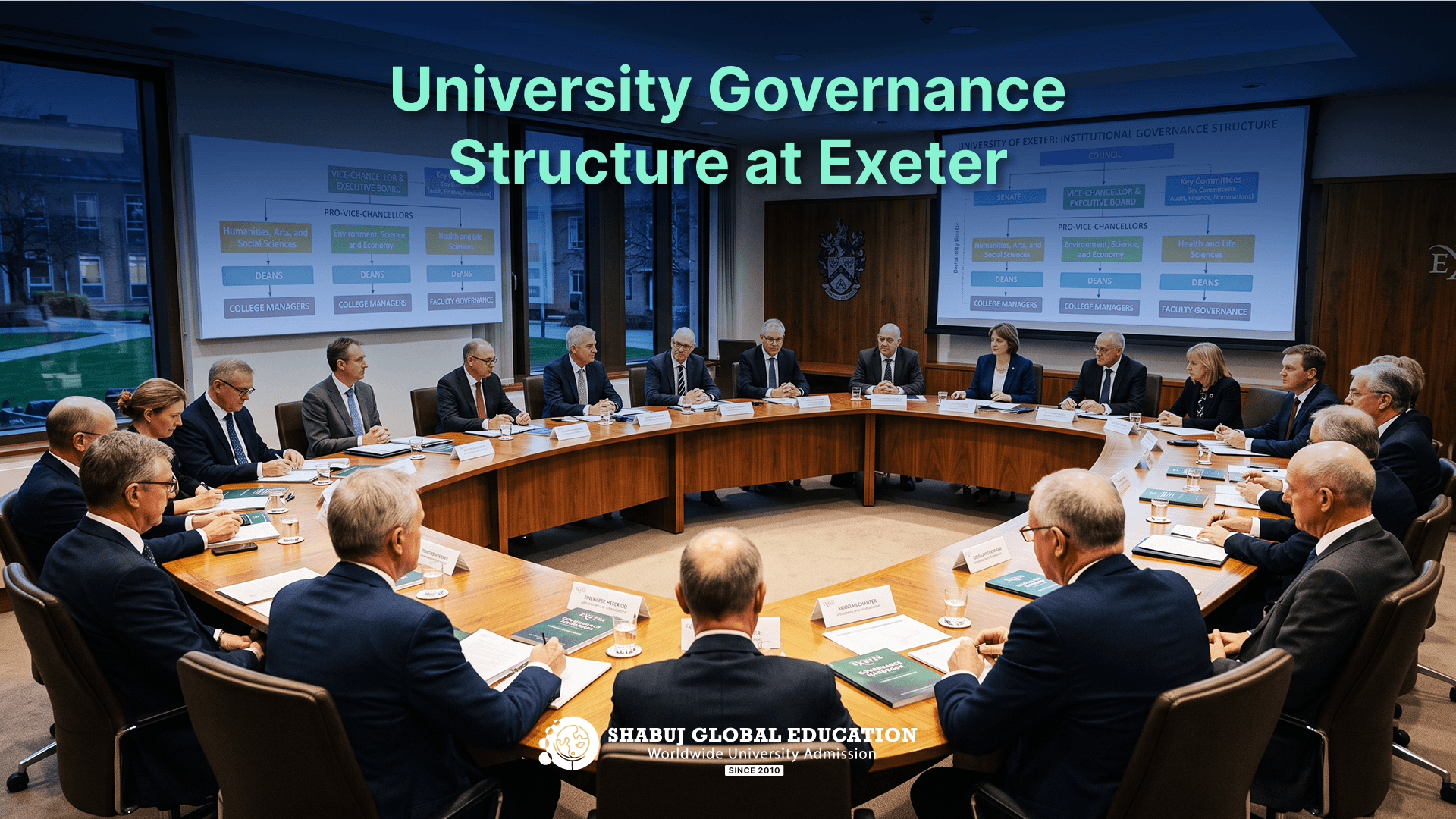
University Governance Structure at Exeter
.png&w=3840&q=60)
2 minutes of reading time
Understand how Council, Senate, the Executive Board, and committees...
Summary
Understand how Council, Senate, the Executive Board, and committees work together to manage university leadership, academic responsibilities, and oversight.
Apply for a UK Scholarship with Expert Guidance – Contact Us Today
Understanding who runs a university can be confusing. The University Governance Structure at Exeter brings together governing bodies, academic leadership, senior management and committees to guide the institution.
In this article, we explain who has responsibility for Exeter and how its main governance bodies work together.
How University Governance Works at Exeter

The University of Exeter has a structured system that separates governance, academic leadership and day-to-day management.
The university describes the Council as its governing body, while the Senate is its senior academic forum. Responsibility for managing the University and delivering its corporate strategy rests with the University Executive Board (UEB), which is chaired by the President and Vice-Chancellor.
This means there is not one person or one committee making every decision. Different bodies have different responsibilities, with reporting and delegation arrangements helping connect them.
At a simple level, the structure can be understood like this:
Council: Governing body with overall oversight and assurance.
Senate: Senior forum where academic staff help shape academic strategy.
President and Vice-Chancellor: Leads the University and chairs UEB and Senate.
University Executive Board: Responsible for management and delivery of corporate strategy.
Committees: Provide detailed scrutiny, oversight, advice and delegated decision-making.
Governance Services: Supports Council, Senate and other senior committees.
For a wider overview of the University's governance and policy environment, see our parent guide, University Governance and Policies at Exeter.
University Council and Its Role
What does the Council do?
Council is the Governing Body of the University. Its role is focused on overall oversight, strategy, institutional direction and assurance rather than the everyday management of the University.
The University states that Council has ultimate assurance and oversight responsibility for all University activities. This includes the University's future strategy and finances, as well as creating an environment in which Exeter's mission can be achieved.
Council's primary responsibilities include agreeing the University's mission, strategic vision and values with the Executive. It also considers long-term academic and business plans, key performance indicators and institutional performance.
This gives Council an important position at the top of Exeter's governance structure.
Who sits on Council?
Council includes a mixture of University officers, members appointed by Council, members appointed by Senate, a professional services staff member and student members.
The majority of Council members are independent members from the private and public sectors. These members bring professional experience and expertise to the University's governing work.
The Council is chaired by the Pro-Chancellor and Chair of Council. Senior University officers also serve as ex-officio members.
This mixture gives Council a broad range of experience while maintaining links with the University's academic and professional communities.
Council committees
Council does not handle every issue itself. It has several committees that focus on specific areas.
These include:
Audit and Risk Committee
Finance and Investment Committee
Governance and Nominations Committee
Remuneration Committee
Research and Innovation Committee
Council Standing Committee
Academic Governance, Education and Student Experience Committee
These committees allow detailed work to be considered at the appropriate level before information, recommendations or assurance are provided to Council.
Senate and Academic Leadership
What is the Senate?
The Senate is the senior forum for academic staff at Exeter. It provides a place for academic staff to help shape academic strategy, scrutinise plans and raise matters of major strategic importance to the University.
The Senate is chaired by the President and Vice-Chancellor. Its membership includes senior academic and professional leaders, such as the Provost and Deputy Vice-Chancellors, Registrar, Faculty Deans, Pro-Vice-Chancellors, Associate Deans and Heads of Department.
Elected members of the academic community are also represented. Students have representation through members of the Students' Guild and Falmouth and Exeter Students' Union.
The Senate formally meets during the academic year, with a joint meeting involving Council also taking place. Its agendas can include reports from senior University leaders and discussion of major areas of University business and strategy.
The important point is that the Senate provides the academic voice within Exeter's governance structure, while Council has the University's overall governing role.
University Leadership and Management
The President and Vice-Chancellor
The President and Vice-Chancellor have a central leadership role at Exeter.
The role connects the University's governing and management structures. The Vice-Chancellor chairs the Senate and plays a key role in the University's executive leadership through the University Executive Board.
At Exeter, the University Executive Board is responsible for the management of the University and delivery of its corporate strategy.
This creates an important distinction:
Council provides governance and oversight, while the Executive leads management and implementation.
University Executive Board
The University Executive Board (UEB) advises the Vice-Chancellor on the University's management and strategic direction.
UEB meets regularly and has a number of management groups that report to it. Members are responsible for management and development of policy in key areas of University business for which they are accountable.
The board includes senior University leaders such as the:
President and Vice-Chancellor
Senior Vice-President and Provost
Vice-Presidents and Deputy Vice-Chancellors
Senior Vice-President and Registrar & Secretary
Chief Financial Officer and senior executive directors
Other senior executive leaders
The board therefore acts as a central management team. It helps turn strategic direction into practical plans and coordinated action across the University.
Committees and Governance Responsibilities
Committees are an important part of the University Governance Structure at Exeter because they divide complex responsibilities into manageable areas.
For example, Council's committees cover areas such as finance, risk, governance, research and remuneration. They allow specialist issues to receive more detailed consideration.
Some committees also bring together members from different parts of the University. This creates links between governing members, academic leaders and senior management.
The University's governance framework also allows committees to handle responsibilities delegated by Council, Senate and other governing bodies. This means work can be considered by the appropriate group while remaining connected to the body with overall responsibility.
The Governance Services Team supports Council, Senate and other senior committees by helping coordinate meetings, records and governance processes.
How the main bodies work together
The governance structure becomes easier to understand when the roles are viewed as connected rather than separate.
Governance body | Main role |
Council | Overall governance, strategy, oversight and assurance |
Senate | Academic strategy and senior academic discussion |
President and Vice-Chancellor | Overall University leadership |
University Executive Board | Management and corporate strategy delivery |
Council Committees | Detailed oversight and scrutiny in specific areas |
Governance Services | Coordination and support for senior governance |
Council and Senate can also work together through joint committees. This creates a formal connection between the University's governing and academic structures.
This arrangement helps prevent governance from becoming isolated into separate parts. Strategic, academic and management perspectives can be brought together when appropriate.
University governance resource:University Governance Explained by Universities UK
This resource gives readers broader background on how UK universities are organised and governed. It can help readers understand the wider higher education environment while keeping this article focused on Exeter.
Why Governance Matters to Students and Staff
Governance may sound like something that only concerns senior managers, but it affects the direction of the whole University.
Decisions about institutional strategy, resources, leadership and long-term priorities can influence the environment in which students learn and staff work.
For students, understanding the structure can make the University feel less complicated. Instead of seeing Exeter as one large organisation, it becomes easier to understand that different bodies have different responsibilities.
For staff, the structure shows where major strategic, academic and management responsibilities sit.
Most importantly, the system creates clearer accountability. Council provides overall oversight, Senate provides an academic forum, and UEB manages the University's operations and strategic delivery. Committees then provide specialist scrutiny and support across these areas.
Support for Bangladeshi Students from SGE
If you are a Bangladeshi student planning to study at Exeter, Shabuj Global Education (SGE) can help you navigate the application process from start to finish.
SGE provides guidance with course selection, document checks, personal statement review, UK student visa preparation and pre-departure support. The aim is to make your Exeter application clearer and easier to manage.
Not sure which scholarship fits you? Get a Free Consultation with our UK Education Experts.
A Clear Structure for Strong Leadership
The University Governance Structure at Exeter is built around several connected layers. Council provides overall governance and oversight, Senate represents the senior academic forum, and the University Executive Board manages the University's operations and corporate strategy.
Together with specialist committees, senior leaders and governance support teams, these bodies create a structured system for making decisions, assigning responsibility and maintaining accountability across the University.
Ready to start your UK journey? Fill out our form and let's begin your application.
Explore more
Frequently Ask Question



.png&w=256&q=60)