Admissions & Entry Requirements | Courses & Degrees | International Student Support | Study Abroad – UK
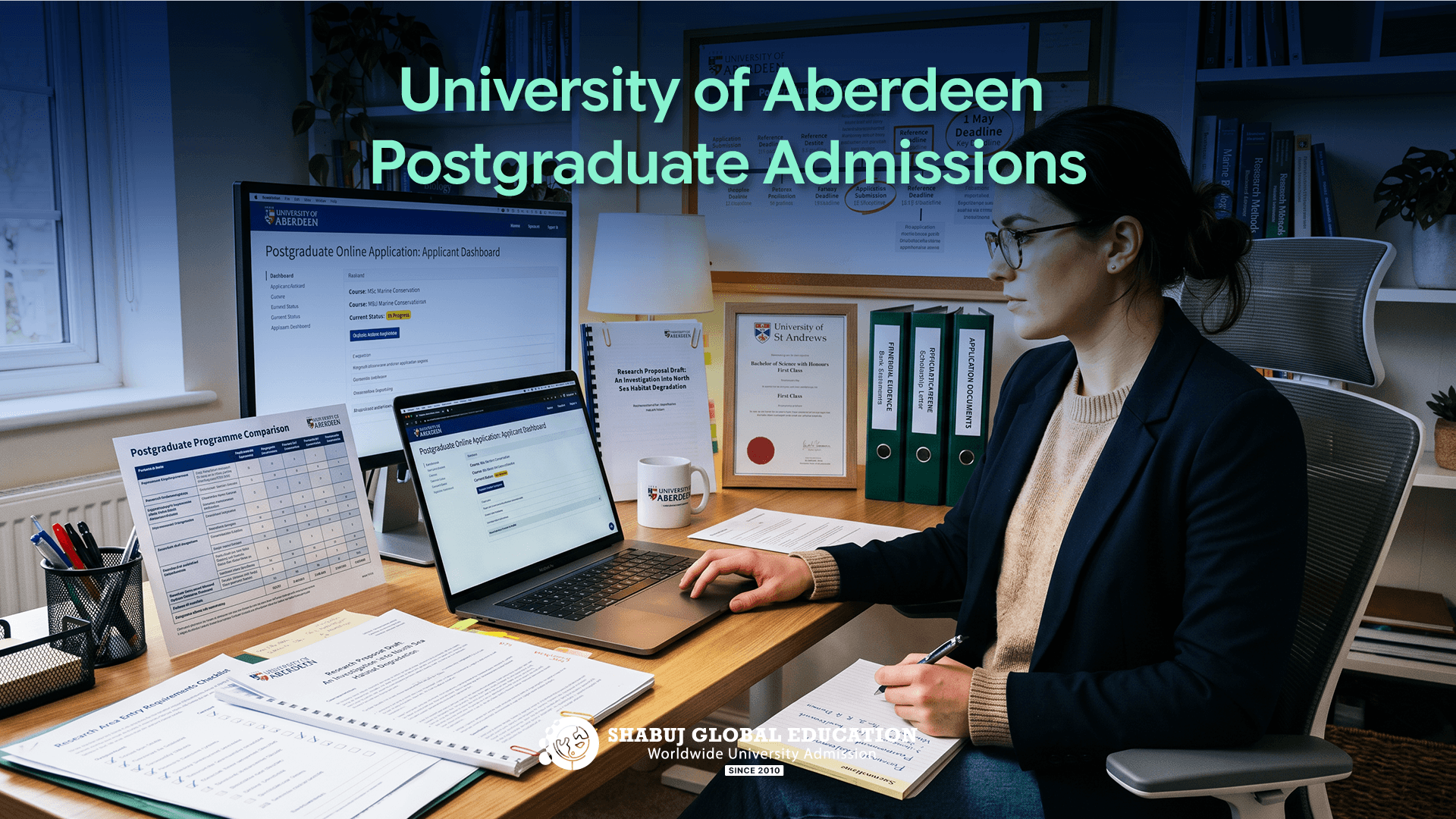
University of Aberdeen Postgraduate Admissions
2 minutes of reading time
A practical guide to University of Aberdeen postgraduate admissions...
Summary
A practical guide to University of Aberdeen postgraduate admissions, covering course selection, entry requirements, application steps, documents, deadlines and offers.
Apply for a UK Scholarship with Expert Guidance -Contact Us Today
Thinking about a master's or research degree in Scotland? University of Aberdeen Postgraduate Admissions involve more than submitting an application. You need to choose the right programme, check your academic background, prepare supporting documents and understand what happens after submission.
This guide explains the University of Aberdeen postgraduate application process from course selection to your next steps as an international student.
Understanding Postgraduate Study at Aberdeen

Postgraduate study at the University of Aberdeen can generally be divided into postgraduate taught and postgraduate research programmes.
Understanding the difference is important because the application requirements are not always the same.
Postgraduate Taught Study
Postgraduate taught programmes include master's-level courses where students normally follow a structured programme of study.
You may attend lectures, seminars, practical sessions and other forms of teaching. Assessment can include coursework, examinations, projects or a dissertation, depending on the programme.
If you are planning an Aberdeen master's application, start by checking the exact programme requirements rather than assuming that every master's course has the same admission criteria.
Postgraduate Research Study
Research degrees have a different focus.
Instead of mainly following a taught course structure, research students work on a substantial research project under academic supervision.
Depending on the programme, this can include qualifications such as MPhil or PhD.
Research applicants therefore need to think carefully about their research area, academic background and whether their proposed work fits the programme and available supervision.
The University advises research applicants to identify an appropriate research area and consider potential supervisors as part of preparing their application.
Choosing a Postgraduate Course
Before starting your Aberdeen postgraduate application, decide what type of programme you want and why it fits your academic or career plans.
The University offers postgraduate study across a wide range of subject areas.
When comparing Aberdeen postgraduate courses, look at:
Course title and subject
Taught or research format
Entry requirements
Required academic background
Course duration
Start date
Tuition fees
English-language requirements
Programme-specific requirements
Research areas and supervision, where relevant
Do not select a master's simply because it is related to your previous degree.
Check the modules and learning outcomes to make sure the course gives you the knowledge and skills you actually want to develop.
For research applicants, the choice requires even more planning. Your research interest should fit the programme and the academic expertise available at Aberdeen.
Resource: For additional guidance on preparing for postgraduate study and applications, see the Prospects postgraduate study guide
Not sure which UK postgraduate course or scholarship fits your profile? Get a Free Consultation with our UK Education Experts.
University of Aberdeen Postgraduate Entry Requirements
University of Aberdeen postgraduate entry requirements vary between programmes.
There is no single qualification or grade that guarantees admission to every postgraduate course.
Undergraduate Degree Requirements
For many postgraduate taught programmes, applicants need an appropriate undergraduate degree or an equivalent qualification.
The required academic level depends on the course.
The University explains that applicants should check the specific entry requirements listed for their chosen postgraduate programme. International qualifications may also be assessed against the University's requirements.
Relevant Subject Background
Some master's courses accept applicants from a broad range of academic backgrounds.
Others may require previous study in a particular subject or related area.
For example, a programme may expect applicants to have studied a relevant discipline before starting postgraduate study.
This is why checking the course page is essential. Do not assume that holding a bachelor's degree automatically makes you eligible for every master's course.
Grade Requirements
Postgraduate programmes can have specific academic grade requirements.
The required classification or equivalent grade depends on the programme and your previous qualification.
International students should check how their qualification and grades compare with the University's requirements for the chosen course.
If you are unsure whether your qualification meets the standard, it is better to clarify this before submitting an application.
English-Language Requirements
International applicants may need to provide evidence of English-language ability.
The University states that applicants whose first language is not English may need to demonstrate that they meet the required English language level for their programme.
The required level can vary by course.
Therefore, check the English-language requirement for your specific programme and confirm that your qualification is accepted.
Programme-Specific Requirements
Some postgraduate courses can have additional requirements.
These may relate to:
Previous subject study
Professional experience
Portfolio work
Interviews
References
Research experience
Research proposals
Other supporting information
Always read the programme requirements before preparing your application.
How to Apply for Postgraduate Study
The University of Aberdeen postgraduate application is normally made through the University's online application system.
The process is different from the undergraduate UCAS route, so postgraduate applicants should not simply follow undergraduate application instructions.
Step 1: Find Your Programme
Start by finding the exact postgraduate programme you want to study.
Check the course requirements, duration, start date and application information.
Step 2: Check Your Eligibility
Compare your previous qualification with the programme's academic requirements.
Check the required degree level, subject background, grades and English-language requirements.
For international applicants, check the University's information for your country or qualification where available.
Step 3: Prepare Your Application Information
Before opening the application, gather the information you are likely to need.
This can include your education history, qualifications, employment information and supporting documents.
Having everything ready makes the online application easier to complete.
Step 4: Complete the Online Application
Enter your personal and academic information accurately.
You should make sure the name and details on your application match your official documents.
Select the correct programme and start date where applicable.
Step 5: Upload Supporting Documents
Upload the documents required for your programme.
Do not upload random documents simply to make the application look complete. Follow the University's instructions and provide the evidence requested.
Step 6: Submit the Application
Review your application carefully before submission.
Check your:
Personal details
Academic history
Qualifications
Course selection
Supporting documents
References
English-language information
Once you are satisfied that the information is accurate, submit the application.
Step 7: Monitor Your Application
After submitting, continue checking your application and email.
The University may contact you if additional information or documents are needed.
Responding quickly can help prevent unnecessary delays.
For a broader overview of the University's application process, you can also read University of Aberdeen Admissions: Key Steps to Apply
Documents for Postgraduate Applications
A major difference between undergraduate and postgraduate applications is the level of supporting information that may be required.
Depending on the programme, your University of Aberdeen postgraduate application may require some of the following:
Degree certificate
Academic transcripts
Personal statement
Academic or professional references
CV
English-language evidence
Passport or identification details
Research proposal for relevant research programmes
Other programme-specific documents
Not every applicant needs every document.
Academic Documents
Your degree certificate and transcripts help the University understand your previous academic study.
If you have not yet completed your degree, the University may ask for current academic information instead.
Make sure your documents clearly show your qualification and results.
Personal Statement
A personal statement may be required for some programmes.
Where required, use it to explain your academic interests, relevant experience and reasons for choosing the programme.
Avoid writing a generic statement that could be sent to any university.
Research Proposal
A research proposal can be important for applicants applying to research programmes.
It should clearly explain the area you want to investigate and show that you have thought carefully about your proposed research.
The exact requirements can vary, so follow the instructions for the research programme you are applying to.
Postgraduate Application Deadlines
There is no single postgraduate deadline for every University of Aberdeen programme.
Deadlines can vary depending on the course, start date and applicant circumstances.
Some programmes may accept applications for a longer period, while others can have specific deadlines.
International students should avoid waiting until the last possible date.
You need enough time not only for the academic application but also for:
Receiving an admissions decision
Meeting offer conditions
Preparing finances
Completing required immigration steps
Arranging accommodation
Preparing for travel
The University advises applicants to check the application deadline for their individual postgraduate programme rather than relying on a general date.
Always check the current course page before applying, as deadlines can change between intakes.
What Happens After You Apply?
After submitting your application, the University assesses it against the requirements of your chosen programme.
For postgraduate applications, the relevant academic area can review your qualifications and supporting information before an admissions decision is made.
The outcome may be:
Conditional offer
Unconditional offer
Request for further information
Unsuccessful application
The University may also contact you if additional evidence is required.
For research applicants, the assessment can involve consideration of the proposed research and academic supervision arrangements.
This is one reason research applications can require more detailed preparation than a standard taught master's application.
Understanding Postgraduate Offers
If your application is successful, read the offer carefully.
Conditional Offer
A conditional offer means you still need to satisfy one or more requirements.
For example, you may need to provide evidence of a completed degree, final results or English-language qualification.
Do not assume that receiving the offer means every admission requirement has been completed.
Unconditional Offer
An unconditional offer means the academic conditions specified in the offer have been satisfied.
However, you should still follow all instructions included with your offer.
Check whether you need to confirm your place, provide additional information or complete other university requirements.
Meeting Your Conditions
If your offer is conditional, work through each condition carefully.
Send the required evidence within the timeframe given by the University.
Keep copies of everything you submit.
Next Steps for International Postgraduate Students
Receiving an offer is only one part of your journey.
International students should start preparing for the next stages as soon as their admission progresses.
Financial Preparation
Plan for tuition fees and living costs before travelling.
Make sure you understand the University's payment requirements and have sufficient funds available for your study period.
Student Visa Preparation
If you need a UK Student Visa, you will need to complete the relevant immigration process after meeting the University's requirements for visa sponsorship.
The University states that international students who require a Student Visa need to meet the relevant immigration requirements before beginning their studies.
An academic offer does not mean your visa is automatically guaranteed.
Prepare your financial and identity documents carefully and allow enough time for the visa process.
Accommodation and Arrival
You should also plan where you will live and how you will travel to Aberdeen.
Start looking at accommodation options early, particularly if you are travelling from Bangladesh and need to organise your move before the academic year begins.
Ready to start your UK journey? Fill out our form and let's begin your application.
Support for Bangladeshi Students via SGE
Shabuj Global Education (SGE) supports Bangladeshi students who are planning postgraduate study in the UK.
Our support can include:
Course Guidance: Help choosing a suitable master's or research programme based on your academic background and career plans.
Application Support: Guidance with preparing and submitting your postgraduate application.
Document Checks: Help checking academic documents and other supporting information.
Personal Statement Guidance: Support with presenting your academic goals and experience clearly.
Visa & Pre-Departure Support: Guidance on the next stages after receiving your university offer.
Ongoing Support: Assistance as you prepare for your transition to studying in the UK.
For Bangladeshi applicants, having a clear application plan can make the process easier to manage from course selection through to arrival.
Postgraduate Application Checklist
Before submitting your Aberdeen postgraduate application, make sure you have checked:
Chosen the correct postgraduate programme
Confirmed whether it is taught or research
Checked the academic entry requirements
Checked the required grade
Confirmed any subject requirements
Checked English-language requirements
Prepared your degree certificate or current qualification evidence
Prepared academic transcripts
Arranged required references
Prepared a personal statement where required
Prepared a CV where required
Prepared a research proposal if required
Checked the programme deadline
Submitted the correct application
Monitored your application after submission
Start Your Postgraduate Application
The University of Aberdeen postgraduate admissions process starts with choosing the right programme and checking its specific requirements. From there, prepare your academic evidence, supporting documents and application carefully before submitting it through the University's postgraduate application route.
For international students, planning should continue after submission. Meeting offer conditions, preparing finances, arranging accommodation and completing visa requirements all form part of getting ready for postgraduate study at Aberdeen.
Ready to start your UK postgraduate journey? Fill out our form and let's begin your application.
Explore more
Frequently Ask Question

.png&w=256&q=60)