Student Wellbeing & Support | Study Abroad – UK
Student Representation and Leadership at Exeter
2 minutes of reading time
Learn how students can take part in representation and leadership a...
Summary
Learn how students can take part in representation and leadership at Exeter, develop practical skills and contribute to university discussions.
Apply for a UK Scholarship with Expert Guidance - Contact Us Today
Starting university is not only about studying. Students can also take an active role in representing their classmates, communities and wider student interests.
Student Representation and Leadership at Exeter gives students opportunities to speak on behalf of others, contribute to university discussions and take part in student-led decision-making.
What Does Student Representation Mean at Exeter?
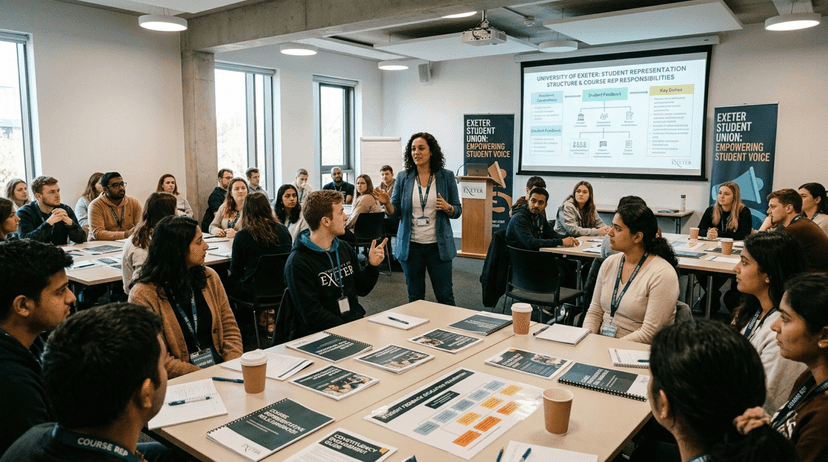
Student representation means that a student takes on a role where they communicate the views, interests or concerns of a wider group of students.
This is different from simply giving personal feedback.
Personal feedback means a student shares their own experience or opinion. Representation means a student has a responsibility to understand wider student views and communicate them in a representative role.
At Exeter, student representation operates across different levels. The University's Teaching Quality Assurance Manual states that enrolled students can volunteer as student representatives, while the Students' Guild and Students' Union manage the recruitment and selection processes for their respective areas.
The University's Student Voice Partnership also provides a formal way for students and staff to work together on education and the student experience. Each programme can have a Student Voice Partnership involving students, teaching staff and the Programme Manager.
This means representation can connect students with academic departments, faculties, university services and wider decision-making structures.
Why Is Student Representation Important?
A university has thousands of students with different courses, backgrounds and experiences. It can therefore be difficult for decision-makers to understand every student perspective individually.
Representatives provide a structured way for wider student views to be communicated.
A representative may help:
Raise issues affecting a group of students
Communicate student priorities
Take part in discussions with university staff
Share information with the students they represent
Help identify concerns that need further attention
Contribute to discussions about education or student life
The role is not simply about speaking for students. It also involves listening, understanding different perspectives and communicating responsibly.
Academic Representatives at Exeter
One of the clearest forms of student representation at Exeter is academic representation.
The University's current Teaching Quality Assurance Manual says student representatives can contribute to university discussions and may, where appropriate, be invited to take on additional responsibilities. These can include involvement in University Working Groups, Faculty-level Education meetings, university service-related representation or academic events.
The Exeter Students' Guild also describes Academic Reps as students who represent other students within their department or faculty. Its academic representation information says the role can cover areas such as teaching, assessment, supervision, course administration, learning resources and career development.
This gives Academic Reps an important position between students and academic teams.
They are not expected to solve university-wide problems themselves. Instead, they can bring student perspectives into the appropriate discussions and help communicate information back to students.
How Can Students Become Representatives?
The exact process can depend on the type of representative position.
The University's 2025/26 Teaching Quality Assurance Manual states that enrolled students are eligible to volunteer as student representatives by applying through the Students' Guild or Students' Union. It also states that these organisations are responsible for determining recruitment and selection processes for their respective areas.
The University also states that the Guild and Students' Union are responsible for managing role descriptions and organising representative training, with support from relevant University teams where appropriate.
Students interested in representation should therefore check the current information provided by the relevant student organisation rather than relying on an older election or recruitment process.
Representation Can Exist at Different Levels
Student representation is not limited to one type of meeting or one student role.
Level | What representation can involve |
Programme or department | Bringing academic concerns and student perspectives into relevant discussions |
Faculty | Representing wider groups of students across academic areas |
University level | Contributing to broader discussions affecting students |
Community level | Representing particular student communities or interests |
Guild or Students' Union | Representing students through recognised student-led structures |
Working groups | Contributing a student perspective to specific areas of university work |
The exact roles and structures can change over time. Exeter's Teaching Quality Assurance Manual specifically allows student representatives to take on additional responsibilities where appropriate and following discussion with the Students' Guild or Students' Union.
Student Officers and Leadership Opportunities
Student representation can also develop into wider leadership.
For 2026/27, Exeter Students' Guild has two elected full-time Officers: Education and Employability Officer and Student Life and Communities Officer. The Guild also introduced part-time Officer roles following its representation review.
The Guild describes its part-time Officers as students who work alongside their studies to represent students, collaborate with Guild and University teams, lead projects and campaigns, and make sure student voices are included in decision-making.
This shows how representation can involve more than attending meetings. Student leaders may also help develop projects, communicate with different groups and work with university teams on issues affecting students.
The University's own governance pages also show student membership at senior governance level. For 2026/27, the Academic Governance, Education and Student Experience Committee includes the Exeter Students' Guild Education and Employability Officer and the President of Falmouth and Exeter Students' Union.
This provides an example of how student representatives can be present in discussions connected with education and student experience at a senior level.
What Do Student Representatives Actually Do?
Being a representative involves responsibility.
A student representative may need to understand different opinions rather than simply promote their own view. They may also need to communicate clearly with both students and staff.
Depending on the role, responsibilities can include:
Listening: Understanding issues affecting the students represented.
Communicating: Sharing relevant information with students.
Representing: Presenting wider student views in appropriate discussions.
Working with staff: Contributing to constructive conversations with university teams.
Following up: Keeping track of issues and discussions where appropriate.
Being inclusive: Considering the experiences of students with different backgrounds and needs.
The University's Teaching Quality Assurance Manual also says that student representatives can receive training organised by the Students' Guild or Students' Union, with support from University departments, faculties or administrative teams where appropriate.
This support can help students understand what is expected from their representative role.
Representation and Leadership Are Not the Same
The two ideas are closely connected, but they are not identical.
Representation focuses mainly on communicating the interests and views of other students.
Leadership can involve taking greater responsibility for projects, campaigns, communities, decisions or wider student initiatives.
A student may therefore begin with a representative role and develop skills that are useful for wider leadership.
The Students' Guild's current student leadership information highlights roles involving collaboration, projects, campaigns and decision-making. Its representation resources also describe opportunities for students to develop leadership, teamwork and interpersonal skills.
Skills Students Can Develop
Taking on a representative or leadership role can provide practical experience in:
Communication
Teamwork
Listening
Public speaking
Problem-solving
Organisation
Negotiation
Project work
Leadership
Working with different people
These skills can also be useful beyond university, particularly when students later enter professional environments where they need to communicate with colleagues, clients or stakeholders.
Can International Students Take Part?
International students can also take part in representative and leadership opportunities where they meet the requirements of the relevant role.
The University of Exeter's Student Ambassador Scheme currently states that applications are welcomed from current students across the University and specifically welcomes applications from groups including international students.
Student representation can also include community-level perspectives. Exeter's student voice information recognises that students belong to different communities, while its wider representation structures provide ways for student interests to be represented beyond individual academic courses.
For an international student, this can be a useful way to contribute a perspective shaped by their own experience while still representing the wider group connected to their role.
Students should always check the current eligibility and recruitment information for the specific opportunity they are interested in.
Representation Connects Students and Staff
Good representation creates a connection between students and the people responsible for university decisions.
At programme level, Exeter states that Student Voice Partnerships include the Programme Manager, teaching staff and students. Reports and recommendations can then move to Programme Meetings or Boards of Studies where relevant.
At a wider level, student representatives can also be involved in University Working Groups and Faculty-level Education meetings when appropriate.
This structure gives representatives a route for bringing student perspectives into discussions rather than leaving students disconnected from university decision-making.
At the same time, a representative does not automatically control the outcome of a discussion. University decisions can involve academic requirements, professional expertise, resources, policies and other evidence.
The representative's role is to bring a student perspective into the conversation.
Student representation can give students a more active role in university discussions by bringing their experiences and perspectives into decision-making processes. It can also support collaboration between students and university staff.
Resource:Student Voice AI - Student Voice in University Governance
Representation vs Personal Feedback
It is useful to understand the difference before deciding which opportunity is right for you.
Personal Feedback | Student Representation |
Usually describes your own experience | Represents a wider student group |
May be given when an issue affects you personally | Involves an ongoing representative responsibility |
Does not require a formal role | Usually involves an appointed, recruited or elected role |
Focuses on sharing your view | Requires listening to different student perspectives |
May be a one-time contribution | Can involve ongoing communication and discussion |
Both can be valuable, but they serve different purposes.
If you want to speak on behalf of other students, a representative opportunity may be more suitable than simply submitting individual feedback.
Support for Bangladeshi Students via SGE
For Bangladeshi students planning to study at Exeter, understanding opportunities beyond the classroom can help you prepare for a more active university experience.
Shabuj Global Education (SGE) supports students through different stages of their Exeter journey:
Expert Guidance: Choose a suitable course based on your academic background and future plans.
Application Support: Get help with documents, application requirements and personal statement preparation.
Visa and Pre-Departure Help: Receive step-by-step support while preparing for your UK student visa and departure.
Ongoing Guidance: Continue receiving support as you move from application to university life.
Once you arrive at Exeter, opportunities such as student representation, societies, volunteering and student leadership can help you become more involved in university life.
Not sure which scholarship fits you? Get a Free Consultation with our UK Education Experts.
Getting Started as a Student Representative
If representation interests you, start by checking the current opportunities available through the University, Students' Guild or Students' Union.
Before applying, think about the students you would represent and the issues that matter to them.
A good representative does not need to have an answer to every problem. Instead, they should be willing to listen carefully, communicate clearly and work constructively with others.
You can also think about which level suits you best. An academic representation role may be useful if you are particularly interested in teaching and learning, while a wider leadership role may involve broader student-life or community issues.
A Simple Way to Think About Representation
Student views → Representative → Discussion with staff or decision-makers → Communication back to students
The exact process will depend on the role, but the principle is straightforward: representatives help connect students with the people and structures involved in university decision-making.
For students considering Exeter, this is one way to look beyond academic study and understand how students can take an active role in university life.
Take Your Next Step
Student Representation and Leadership at Exeter gives students opportunities to represent others, develop practical skills and contribute to discussions that affect university life.
The most important part of representation is not simply having a title. It is understanding the responsibility that comes with speaking for others and communicating their views fairly.
If you are planning to study at Exeter, learning about these opportunities can help you see how you can become more involved after arriving at university.
Related Guide:Student Feedback and Representation at Exeter
Ready to start your UK journey? Fill out our form and let's begin your application.
Explore more
Frequently Ask Question



.png&w=256&q=60)