Study Abroad – UK | University & College Guides
Sustainability and Environmental Programs at Exeter
.png&w=3840&q=60)
2 minutes of reading time
Explore Exeter’s sustainability efforts, including renewable energy...
Summary
Explore Exeter’s sustainability efforts, including renewable energy, biodiversity, waste reduction, sustainable travel, climate action and student environmental projects.
Apply for a UK Scholarship with Expert Guidance – Contact Us Today
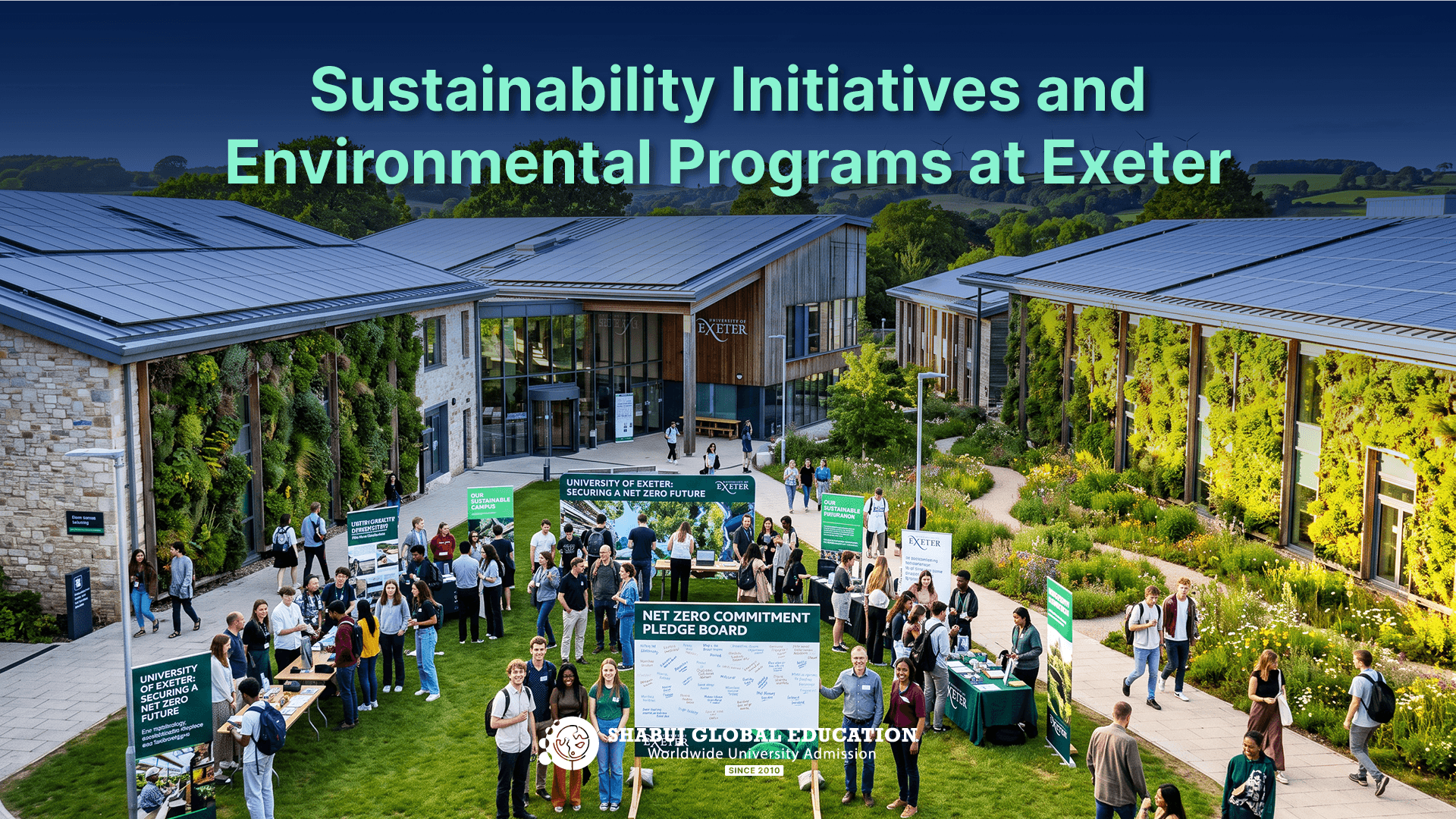
If you want to understand what the University of Exeter is doing for the environment, there is a lot more to explore than recycling bins. Sustainability Initiatives and Environmental Programs at Exeter cover climate action, renewable energy, biodiversity, waste reduction, sustainable travel and student involvement.
The University has committed to carbon net zero across all scopes by 2050 and is pursuing a policy of environmental net gain. Students are also encouraged to take part in sustainability activities, projects and practical changes across campus.
Exeter's Sustainability Approach
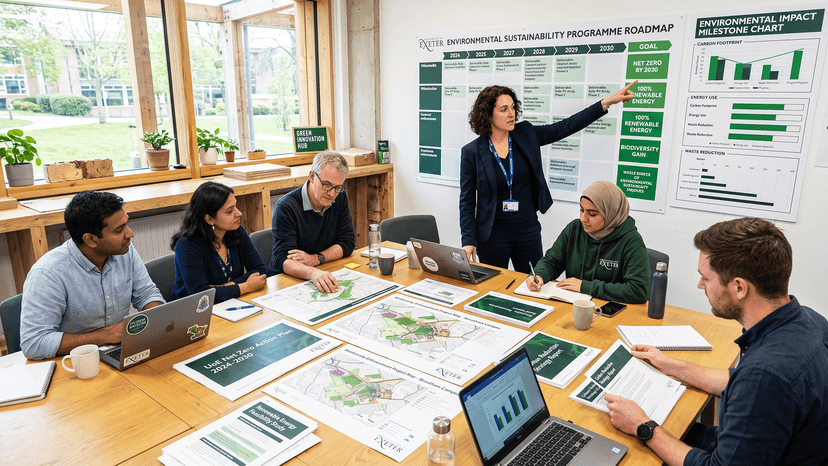
Exeter treats sustainability as part of university life rather than as a separate activity. Its approach covers the way campuses are designed and operated, how energy is used, how waste is managed, how people travel and how biodiversity is protected.
The University has developed a range of strategies and policies covering areas such as climate action, sustainable transport, circular economy and resource management, biodiversity, sustainable food and procurement.
This approach also connects sustainability with education and research. The University provides sustainability-related teaching, events, internships, funding and advice to help students develop environmental knowledge and skills, regardless of what subject they study.
For students who want an overview of how environmental work fits into Exeter's wider community goals, see our Community Engagement and Sustainability at Exeter guide. This gives the broader picture, while this article focuses specifically on environmental action.
Exeter's Environmental Targets
One of Exeter's major long-term commitments is to reach carbon net zero across all scopes by 2050.
The University is also working towards becoming a Nature Positive University. Its Nature Positive Strategy includes a commitment to increase the biodiversity value of its campuses by 20% by 2030 through habitat improvements and better monitoring.
These targets show that sustainability at Exeter is not limited to small lifestyle changes. The University is also changing infrastructure, energy systems, land management and campus operations.
Climate and Environmental Action
Climate action is a major part of Exeter's sustainability work.
The University is working to reduce emissions from its operations and wider activities. Its Climate Strategy focuses on reducing carbon emissions at source, while other strategies address travel, buildings, energy and resource use.
The University's 2024/25 annual reporting shows that scope 1 emissions were 6,329 tonnes of CO₂e, a 3% reduction from the 2023/24 baseline. Scope 2 emissions were affected by changes in electricity tariffs during the year, with Exeter returning to a zero-carbon electricity tariff from April.
This matters because climate action is not only about encouraging students to change their habits. Large institutions also need to reduce emissions from buildings, heating, electricity, transport and other operations.
Research and Environmental Projects
Environmental sustainability is also connected to research and practical projects at Exeter.
The University supports sustainability-related research and encourages researchers to consider environmental impacts when planning projects and applying for funding. Its Environmental Sustainability Concordat sets expectations for researchers to consider environmental sustainability in research and innovation.
Students can also gain practical experience through environmental projects. The Green Consultants Projects, for example, allow students to work in groups on real projects connected to the University's Climate Strategy and Nature Positive Strategy. Each student works for 30 hours as part of a group of four.
Projects have included work on waste and recycling, circular economy, sustainable transport and biodiversity.
Biodiversity and Nature
Protecting nature is another important part of Exeter's environmental work.
The University has committed to increasing the biodiversity value of its campuses by 20% by 2030. To measure progress, the University is carrying out habitat monitoring and collecting ecological data across its campuses.
This work can involve surveying habitats, mapping areas and understanding how campus land can better support wildlife.
Recent biodiversity work has included habitat surveys across Streatham, St Luke's and Penryn campuses. In 2026, biodiversity survey field assistants worked with the Sustainability Team to survey ornamental and grassland habitats and update habitat maps.
Students can also become involved in practical environmental activities. The University has highlighted opportunities including biodiversity projects, sustainability volunteering and the community garden as ways students can get involved.
The Sustainability Projects Fund has also supported environmental activities such as tree propagation, nesting box creation and sustainability volunteering on Penryn Campus.
Energy and Carbon Reduction
Energy use is another major part of Exeter's environmental strategy.
The University says it has used renewable electricity since 2017, with electricity supported by Renewable Energy Guarantees of Origin. Exeter has also invested in renewable energy generation through solar panels across its campuses.
The University reports around 1.5 megawatts of energy from campus solar PV, with further potential to expand solar generation across its assets. The Duryard solar project has also been completed, while solar panels have been installed on buildings including the Harrison Building.
Building design is also part of the strategy. Exeter's sustainable design standards use approaches such as whole-life carbon assessments for larger projects and encourage high-performance building standards to reduce energy and carbon impacts.
What Can Students Do?
Students cannot control the University's energy infrastructure, but they can reduce unnecessary energy use in everyday life.
Simple actions include:
Switching off lights when they are not needed.
Unplugging chargers when they are not being used.
Avoiding heating rooms while windows are open.
Reporting leaks or maintenance problems.
Using energy and water carefully in accommodation.
The University's accommodation guidance specifically encourages students to take these steps to reduce energy and water consumption.
Waste and Recycling
Waste management is another clear area where students can make a direct difference.
Exeter has introduced Dry Mixed Recycling bins across campus. Clean and dry recyclable materials can go into these bins, including paper, flattened cardboard, cans and certain plastic packaging.
However, not everything belongs in a recycling bin.
For example, Exeter states that glass, ceramics, food-soiled paper, polystyrene and certain food packaging should not go into the Dry Mixed Recycling bins. Incorrect items can contaminate recycling loads.
The University reported that approximately 95% of its waste in 2024/25 was recycled, composted, combusted or sent for anaerobic digestion. It is also working through its Circular Economy and Sustainable Resource Management Strategy to reduce waste and increase reuse.
Reduce Before You Recycle
Recycling is useful, but Exeter's guidance places importance on avoiding waste and reusing items before recycling or disposal.
Students can support this approach by:
Choosing reusable bottles and cups.
Avoiding unnecessary single-use products.
Reusing items where possible.
Sorting waste correctly.
Checking whether unwanted items can be donated or reused.
The University also runs initiatives designed to encourage reuse and reduce waste, including projects connected with moving out and resource management.
Sustainable Travel
Travel has a major environmental impact when thousands of students and staff travel to and between campuses.
Exeter's sustainable travel approach aims to reduce pressure on the environment, lower carbon emissions and encourage alternatives to single-occupancy car journeys. The University supports options including walking, cycling, public transport and car sharing.
The University also operates a free bus service connecting Exeter St David's, Streatham Campus and St Luke's Campus. Students can use walking routes and public transport options to reduce their dependence on private cars.
The University has set a goal to reduce commuting-based emissions by 20% by 2030. Its travel survey is used to understand how students and staff travel and where transport options can be improved.
If driving is necessary, Exeter encourages car sharing because sharing journeys can reduce single-occupancy trips, congestion and emissions. Students and staff can use the University's Mobilityways community for car sharing.
Not sure which scholarship fits you? Get a Free Consultation with our UK Education Experts.
Student Sustainability Activities
Students are not simply observers of Exeter's environmental work. The University provides several ways for students to participate.
One example is the Sustainability Projects Fund. The fund supported small and medium-sized sustainability projects and was open to University students and staff. For the second round, students had to apply through a named staff member who would oversee the project.
The fund has supported projects connected with:
Biodiversity and nature
Circular economy
Waste reduction
Sustainable travel
Energy
Environmental education
Examples included campus sustainability volunteering, tree propagation, nesting box projects, repair activities and projects looking at travel behaviour.
Students can also develop sustainability skills through Green Consultants projects. These projects give students the chance to work on real university challenges and produce a practical final output.
Sustainability Education
Environmental involvement does not always mean physical volunteering.
Exeter offers sustainability education, events, internships and employability opportunities to students from different academic backgrounds. This means a student studying business, law, engineering, science or another subject can explore how sustainability connects with their field.
This can be useful if you want to build environmental knowledge while also developing skills relevant to your future career.
How Students Can Support Exeter's Environmental Goals
You do not need to join a major environmental project to contribute.
A student can support Exeter's sustainability goals by making practical choices every day and taking part in opportunities when they become available.
Start with Your Daily Habits
Focus on the areas you can control:
1. Recycle correctly.
Use the correct campus bins and keep recyclable materials clean and dry.
2. Reduce waste.
Think about whether something can be reused before throwing it away.
3. Use sustainable transport.
Walk, cycle or use public transport where practical. Consider car sharing if you need to drive.
4. Reduce energy use.
Switch off lights, unplug chargers and avoid wasting heat.
5. Get involved.
Look for sustainability projects, biodiversity activities, Green Consultants opportunities, internships or student-led environmental activities.
6. Share useful ideas.
Exeter encourages students to engage with its sustainability agenda, and the University provides channels for feedback and ideas.
A Simple Student Sustainability Checklist
Area | What students can do |
Energy | Switch off lights and avoid unnecessary heating |
Waste | Reduce, reuse and recycle correctly |
Biodiversity | Join relevant nature or campus activities |
Travel | Walk, cycle, use public transport or car share |
Projects | Explore Green Consultants and sustainability projects |
Learning | Join sustainability events and educational activities |
Daily choices | Use reusable items and avoid unnecessary waste |
Support for Bangladeshi Students via SGE
For Bangladeshi students planning to study in the UK, understanding Exeter's campus and sustainability environment is only one part of preparing for university life.
Shabuj Global Education (SGE) provides support with university selection, applications, scholarships, visa and immigration guidance, and pre-departure preparation. This can help students approach the UK application process with clearer information and a structured plan.
Ready to start your UK journey? Fill out our form and let’s begin your application.
For students who want application guidance before choosing their university, Shabuj Global Education provides a free consultation route where prospective students can discuss their study plans with education advisers.
Start Your Sustainability Journey
The Sustainability Initiatives and Environmental Programs at Exeter show that environmental action covers much more than recycling. Renewable energy, biodiversity, carbon reduction, waste management, sustainable travel, research and student projects all contribute to Exeter's environmental goals.
As a student, you can support this work through simple daily choices and by taking part in suitable sustainability activities. Small actions are useful, but active participation gives you the chance to make a bigger contribution to the University's environmental goals.
Explore more
Frequently Ask Question



.png&w=256&q=60)