Admissions & Entry Requirements | Student Recruitment & Admissions | Study Abroad – UK
University of Reading Undergraduate Admissions: Key Steps
2 minutes of reading time
A step-by-step guide to University of Reading undergraduate admissi...
Summary
A step-by-step guide to University of Reading undergraduate admissions, covering UCAS applications, entry requirements, documents, deadlines and offers.
Apply for a UK Scholarship with Expert Guidance -Contact Us Today
Planning to apply for an undergraduate degree at Reading? This University of Reading Undergraduate Admissions: Key Steps guide explains how the application works, from choosing your course and checking entry requirements to applying through UCAS and responding to an offer.
If you are an international student, understanding each stage early can help you prepare the right qualifications and documents before you apply.
Who Can Apply for Undergraduate Study at Reading?
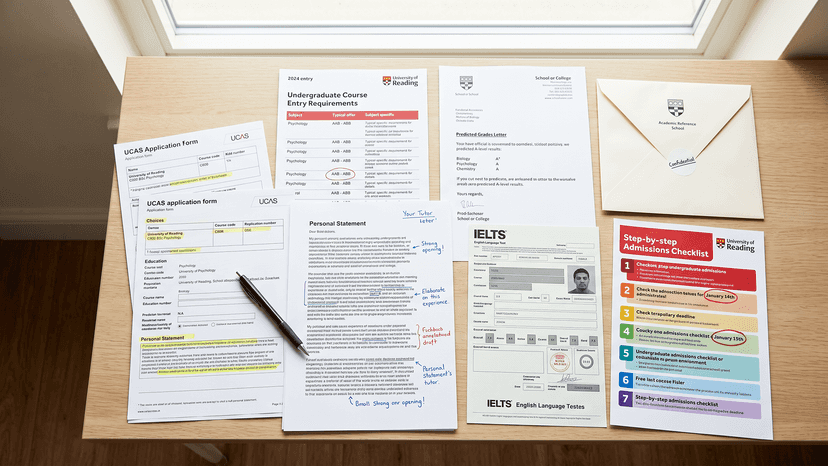
The University of Reading accepts a wide range of UK and international qualifications for undergraduate study. However, the requirements are not the same for every course.
Each undergraduate degree has its own entry requirements. Some courses may require particular subjects, grades or previous academic knowledge. Reading also considers qualifications such as A levels, BTEC qualifications and the International Baccalaureate, along with many equivalent qualifications.
Before starting your University of Reading undergraduate application, check the specific course page carefully.
You should look for:
Required academic qualifications
Expected grades
Required subjects
English language requirements
Any additional course requirements
Available foundation or alternative routes
Meeting the general requirements does not automatically mean you will receive an offer. Reading states that applications are considered individually, and the conditions of any offer are explained in the offer letter.
How to Find an Undergraduate Course
The first practical step in the University of Reading undergraduate admissions process is choosing a course that matches your academic interests and future plans.
Reading provides a range of undergraduate courses across different subject areas. When comparing courses, do not look only at the course title. Check the course content, duration, entry requirements and any subject-specific conditions.
A useful approach is to make a short list of courses and compare them before beginning your UCAS application.
What to check | Why it matters |
Course content | Helps you understand what you will study |
Entry requirements | Shows the qualifications and grades expected |
Subject requirements | Some courses need specific previous subjects |
English requirements | International students may need to prove English ability |
Course duration | Helps you plan your undergraduate study |
UCAS information | Helps you use the correct course details when applying |
Do not choose a course only because you meet its minimum academic requirement. Make sure the subject itself fits your interests and long-term plans.
Start with the Parent Guide
For a wider overview of the University's application journey, see University of Reading Admissions: Your Essential Guide.
Check the Entry Requirements
Checking University of Reading undergraduate entry requirements should happen before you complete your application.
Reading says that many undergraduate course offers are expressed using A level, BTEC and International Baccalaureate requirements. The University also accepts many other qualifications and provides information for international applicants.
Some courses have additional subject requirements. For example, a course may expect previous study in a particular subject or specific grades.
Reading normally expects undergraduate applicants to demonstrate a good general education, including acceptable levels of literacy and numeracy. This is usually equivalent to at least grade C at GCSE in English and Mathematics, although some courses may have different or additional requirements.
The safest approach is simple:
Check your exact course page before applying.
Requirements can also be updated, so avoid relying on an old prospectus, social media post or third-party website.
Understand Your Qualification Requirements
International students should check how their existing qualification compares with Reading's undergraduate requirements.
The University accepts a wide range of overseas qualifications. It provides country-specific information to help applicants understand whether their qualifications are suitable for their chosen level and course.
Applying to the University of Reading from Bangladesh
The University of Reading provides specific guidance for students from Bangladesh.
According to its Bangladesh guidance, the University recognises the Higher Secondary School Certificate as part of its country-specific qualification information. For undergraduate degree study, Reading states that a completed Higher Secondary School Certificate combined with a successfully completed appropriate foundation or bridging programme can be considered. It also lists other accepted qualifications for undergraduate entry.
For students considering a foundation route, Reading's International Foundation Programme information currently lists Higher Secondary Certificate (HSC) 70% and above for Bangladesh as an entry requirement for that foundation route. This requirement relates specifically to the International Foundation Programme and should not be treated as a universal direct-entry requirement for every undergraduate degree.
This distinction is important for Bangladeshi applicants.
Direct undergraduate entry and foundation entry are not the same route. Check the requirements for your chosen degree and pathway before deciding which route applies to you.
Check English Language Requirements
International applicants may need to show that they have the required level of English for undergraduate study.
The University of Reading states that English requirements vary by course. For its general undergraduate requirements, the current guidance lists IELTS Academic 6.5 overall with no component below 5.5 as one accepted option. Reading also accepts several other English language qualifications.
Some programmes have higher requirements. For example, Reading states that Speech and Language Therapy requires IELTS 8.0 overall with no less than 7.5 in each component. Pharmacy and Nutrition have different requirements from the general undergraduate level.
Therefore, do not assume that one English score applies to every course.
Check the English requirement shown for your specific degree before booking a test.
If you do not currently meet the required level, Reading also provides pre-sessional English options for eligible students.
How to Apply Through UCAS
The University of Reading UCAS application is the main route for undergraduate applicants.
Reading states that you can apply online through UCAS for all of its undergraduate courses, including courses with an Integrated Foundation Year. Applicants can apply for up to five courses, including more than one course at the same university.
The basic process is:
Register with UCAS.
Find your chosen Reading course.
Use the correct UCAS course details and code.
Enter your personal and educational information.
Add your qualifications and grades.
Complete your personal statement.
Add your reference.
Check the application carefully.
Submit the application through UCAS.
The University of Reading's UCAS code is R12, while individual courses have their own course codes. Reading advises applicants to use the UCAS codes shown on its course pages.
Resource: UCAS undergraduate application information UCAS is the application platform used for UK undergraduate applications. Use it to manage your application and check current application guidance and dates.
Documents and Personal Statement
Your University of Reading undergraduate application needs accurate academic and personal information.
You should be prepared to provide information about your qualifications and grades. Your application also includes a personal statement and reference. Reading says that its admissions team generally considers information such as your personal statement, predicted or achieved grades and the reference provided by your school or college.
Your personal statement should explain why you want to study the subject and show relevant interests, skills and experience.
Instead of filling the statement with general claims, focus on information that demonstrates your interest in the subject.
For example, you could discuss:
Why the subject interests you
Relevant academic work
Activities connected to the subject
Skills you have developed
Relevant experience
What you hope to learn from the degree
Keep your information honest and relevant to the course.
Before submitting, check spelling, dates, grades and course details carefully.
Undergraduate Application Deadlines
Most undergraduate courses at Reading have their UCAS application deadline in January. However, the University advises applicants to check the UCAS website for the latest deadline because dates can change.
If you miss the January deadline, Reading states that you can still apply through UCAS and that it is happy to consider late applications until June. Applications received after June are entered into Clearing. However, some courses may already be full after the January deadline.
For this reason, applying early can give you more options.
Do not wait for the deadline if your application is ready.
International students should also allow extra time to prepare qualifications, English language evidence and other documents.
What Happens After You Submit Your Application?
After you submit your UCAS application, UCAS sends it to the University of Reading's Admissions Office.
The University's Admissions Team then assesses your application. The assessment process can vary depending on the course. Some courses may require an interview, portfolio or another additional assessment.
You can track your application through UCAS Hub.
If Reading decides to offer you a place, you may receive either a conditional offer or an unconditional offer.
A conditional offer means you still need to meet specific conditions, such as achieving required grades or providing additional information. An unconditional offer means you have already met the course requirements.
Once you receive your offers, you can decide which offer to accept through the UCAS process.
What If You Do Not Meet the Direct Entry Requirements?
Not meeting the direct entry requirements does not always mean that studying at Reading is impossible.
For some international students, a foundation pathway can provide an alternative route into undergraduate study.
The University of Reading offers International Foundation pathways designed to help international students meet the academic, subject-specific and English language requirements needed for progression to undergraduate study.
Reading also offers undergraduate degrees with an Integrated Foundation Year in some subject areas. These programmes combine a foundation year with the degree route.
However, foundation routes have their own requirements and may not be available for every degree.
Check the pathway connected to your intended course before applying.
International Students Applying to Reading
International students should plan their University of Reading undergraduate admissions journey carefully.
Along with academic requirements, you may need to consider English language evidence, country-specific qualifications and the correct application route.
For Bangladeshi students, Reading's country-specific guidance is particularly useful because it explains how qualifications such as the Higher Secondary School Certificate relate to its study routes.
Support for Bangladeshi Students via Shabuj Global Education
Shabuj Global Education (SGE) can support Bangladeshi students throughout their UK university application journey.
Expert Guidance: Get help choosing a Reading course that matches your academic background and future goals.
Application Support: SGE can assist with document checks, application preparation and personal statement review.
Visa and Pre-Departure Help: After you receive the required university documentation, SGE can provide guidance on the next stages of your UK study journey.
Ongoing Support: Support can continue as you prepare for departure and transition into university life.
Not sure which scholarship fits you? Get a Free Consultation with our UK Education Experts.
Final Step: Prepare Early
The University of Reading Undergraduate Admissions: Key Steps are straightforward when you approach them in the right order: choose your course, check the requirements, understand your qualification route, prepare your information, complete your UCAS application and submit it before the relevant deadline.
For international students, starting early is especially useful because you may need additional time to confirm qualifications and English language requirements.
Ready to start your UK journey? Fill out our form and let's begin your application.
Contact Shabuj Global Education
Explore more
Frequently Ask Question